Do DTV Visa Holders Pay Thai Tax? Remote Work, the 180-Day Rule and Money You Bring In (2026)
Updated Sat, 21 November 2026
Count your days in Thailand this year →The Destination Thailand Visa (DTV) lets remote workers and freelancers stay up to 180 days per entry, with one 180-day extension, for five years (DTV requirements guide). A common question is whether holding a DTV makes you pay Thai tax, or protects you from it. The short answer: it does neither. Thai tax depends on how many days you spend in Thailand, where your income comes from and what you bring into the country, not on your visa.
This guide is general information from the Revenue Code and Revenue Department publications. It is not tax advice.
The three rules that matter
Section 41 of the Revenue Code sets out who pays Thai personal income tax (Revenue Department: Revenue Code, Sections 38 to 64):
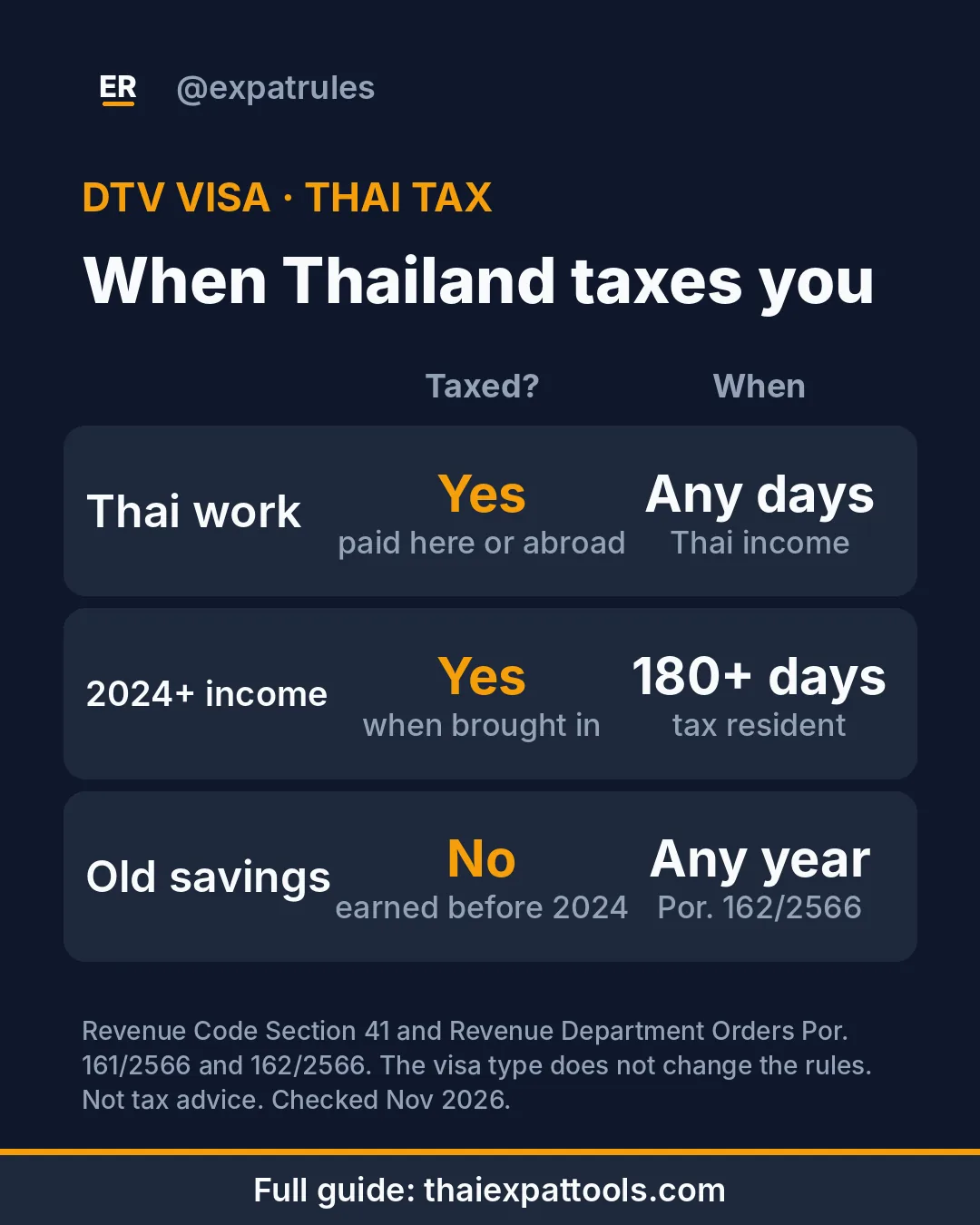
- Income from work done in Thailand is Thai income. The Code taxes income from employment or business carried on in Thailand whether it is paid in Thailand or abroad. This rule does not depend on the 180 days.
- 180 days makes you a tax resident. Anyone who stays in Thailand for a period or periods adding up to 180 days or more in a tax year (the calendar year) is a resident for that year.
- Residents are taxed on foreign income they bring in. A resident pays tax on income from work, business or property abroad when it is brought into Thailand.
Nothing in these rules mentions the DTV or any other visa. The 180-day count is about days in the country only.
Rule 1: working in Thailand for a foreign client or employer
The DTV is designed for people who work remotely for employers or clients outside Thailand. Under Section 41, though, what counts is where the work is done, not where the client or the bank account is. Income for work you do while you are in Thailand falls under the first rule, “whether such income is paid within or outside Thailand”.
How the Revenue Department applies this to individual remote workers, and how a tax treaty with your home country affects it, depends on your facts. If you work from Thailand for long periods, get advice from a Thai tax adviser or call the Revenue Department on 1161.
Rule 2: when a DTV holder becomes a tax resident
With 180 days per entry plus a 180-day extension, a DTV holder can easily reach 180 days in one calendar year. The days do not have to be in a row: two stays of 90 days in the same year make you a resident, while a single 200-day stay from October to April may not, because it is split across two calendar years.
The 180-day tax residency counter adds up your stays for each year and shows how many days you have left before you reach 180.
Rule 3: money you bring into Thailand
Since 1 January 2024, Revenue Department Order Por. 161/2566 says a resident’s foreign income is taxable in the year it is brought into Thailand, even if it was earned in an earlier year. Order Por. 162/2566 keeps income earned before 1 January 2024 out of the tax, even if you bring it in later (Por. 161/2566, Thai; Revenue Department: Manual for Foreign Tax Credit).
For a DTV holder that means:
- Salary or freelance income earned from 2024 and transferred to a Thai account in a year you are a resident is taxable.
- Savings from before 2024 are not taxed when you bring them in. Keep bank records that show when the money was earned.
- Money you leave abroad is not taxed by Thailand under this rule.
- The 500,000 THB you showed for your DTV application is treated like any other money: what matters is when it was earned and whether you bring it in during a resident year.
You may have read about a planned exemption for foreign income brought in during the same or the next year. As of 21 November 2026 it is still a draft and has not been published in the Royal Gazette, so it is not law (ThaiLawOnline tracker). Por. 161/2566 still applies.
How much tax: a worked example
Thai income tax is progressive. The first 150,000 THB of taxable income is taxed at 0%, then the rates rise in steps from 5% to 35% above 5,000,000 THB (PND 90 guide).
Example: a remote worker spends 200 days in Thailand in 2026, so is a resident. During the year they transfer 1,200,000 THB of salary earned in 2026 and 300,000 THB of savings from 2022 into a Thai account.
| Step | THB |
|---|---|
| Salary brought in | 1,200,000 |
| Employment expense deduction (50%, capped) | -100,000 |
| Personal allowance | -60,000 |
| Taxable income | 1,040,000 |
| Tax on 1,040,000 | 125,000 |
| Savings from 2022 | 0 tax |
The expense deduction is 50% of employment income up to 100,000 THB, and the personal allowance is 60,000 THB (Revenue Department PND 90 guide). Other allowances and a tax treaty credit could lower the bill. The foreign income remittance tax calculator runs this sum with your own numbers, and the Thai income tax calculator shows each bracket.
Tax treaties and tax paid at home
If you already paid tax on the same income in another country, you may be able to claim a foreign tax credit, but only where Thailand has a double tax agreement with that country. The credit cannot be more than the Thai tax on that income (Manual for Foreign Tax Credit). Keep your home tax return, proof of payment and transfer records.
Do you need to file a return?
If your income that Thailand taxes is over the filing limit, you must file a return, even if the tax due comes to zero. For income other than salary only, the limit is 60,000 THB a year (120,000 THB for a married couple); for salary only it is 120,000 THB (220,000 THB for a couple). Paper returns are due 31 March of the next year, with 8 extra days online. You need a Thai tax ID, applied for on form L.P. 10.1 (PND 90 guide; PND 91 guide; Tax ID). Our step-by-step filing guide walks through it.
Quick checklist for DTV holders
- Count your days in Thailand for each calendar year.
- Write down which income comes from work done while you were in Thailand.
- If you reach 180 days, list every transfer into Thailand and when that money was earned.
- Keep savings from before 2024 in a separate account if you can, so you can prove their date.
- Check your tax treaty, and file by 31 March if you are over the limit.
Sources
- Revenue Department: Revenue Code, Sections 38 to 64 (English) (Section 41: work in Thailand paid in or outside Thailand, foreign income of residents when brought in, 180 days in a tax year)
- Revenue Department Order Por. 161/2566 (Thai) (foreign income taxed when brought in, from 1 January 2024)
- Revenue Department: Manual for Foreign Tax Credit (November 2025) (180-day residence, income from before 2024, foreign tax credit limits)
- Revenue Department: Guide to Personal Income Tax Return 2024 (PND 90) (rate table, 50% / 100,000 THB expense deduction, filing limits, 31 March)
- Revenue Department: Guide to Personal Income Tax Return 2024 (PND 91) (salary-only filing limits)
- Revenue Department: Tax Identification Number (form L.P. 10.1)
- ThaiLawOnline: remittance exemption tracker (draft exemption not in the Royal Gazette; news tracker, not an official source)
This guide is general information, not tax advice. For your own situation, ask the Revenue Department (call centre 1161) or a Thai tax adviser.
Count your days in Thailand this year →This guide is general information, not legal or tax advice. Rules change, so confirm with Thai Immigration, the Revenue Department or a professional.