Thailand Marriage Visa 2026: Non-O Requirements, the 400,000 THB Rule and the 1-Year Extension
Updated Sat, 14 November 2026
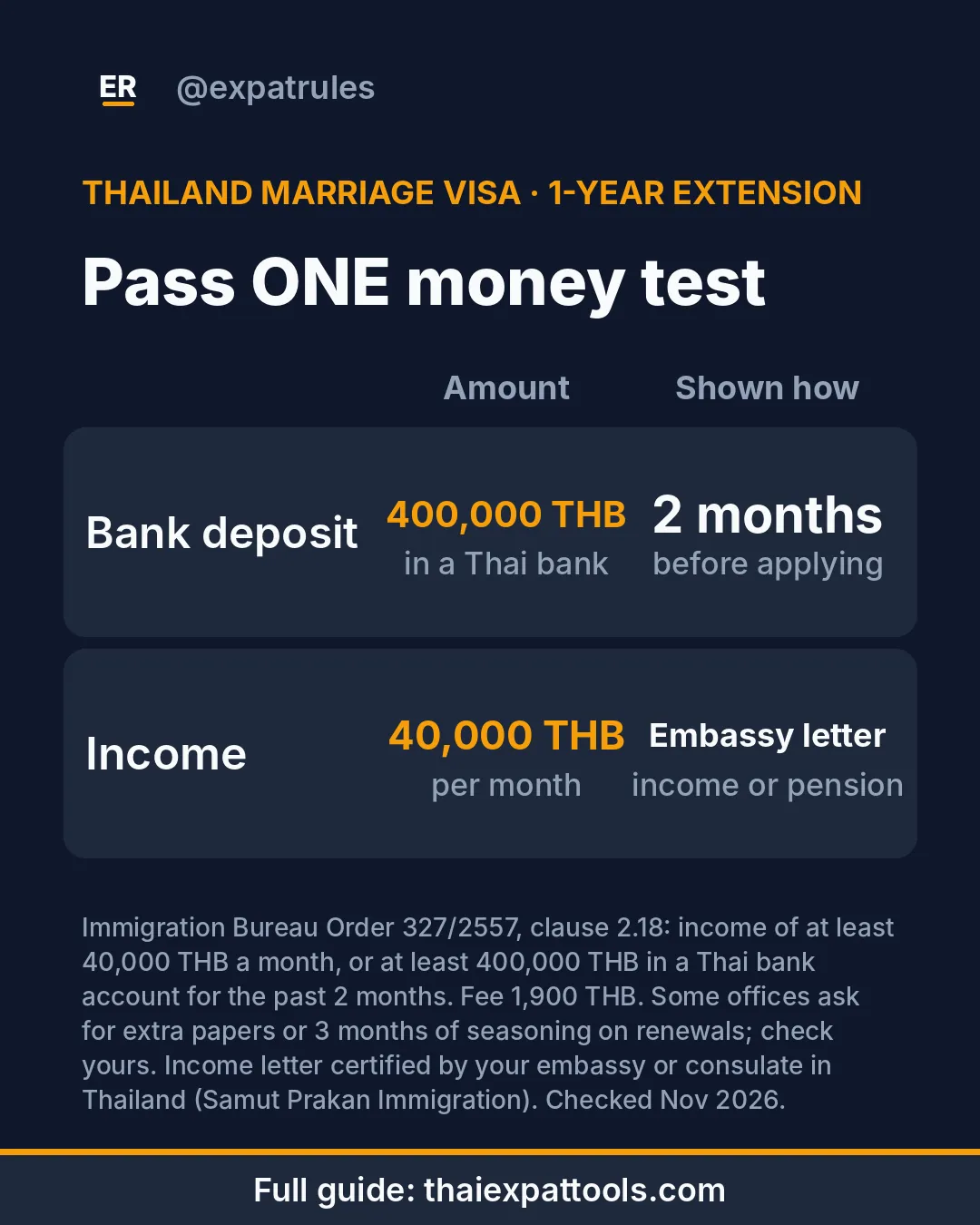
Check which Thai visa fits you →If you are married to a Thai citizen, the usual way to live in Thailand is the Non-Immigrant O visa based on marriage, often called the marriage visa. It is a two-step route: you get a 90-day Non-O visa, then you extend it inside Thailand one year at a time. The money rule is half the retirement rule: 400,000 THB in a Thai bank, or 40,000 THB a month of income.
The two steps at a glance
| Step | Where | What you get | Money |
|---|---|---|---|
| 1. Non-O visa | Thai embassy or consulate (e-Visa) | Single entry, 90 days of stay | Set by each embassy, often 400,000 THB in savings |
| 2. 1-year extension | Your local immigration office in Thailand | 1 more year, renewable every year | 400,000 THB in a Thai bank for 2 months, or 40,000 THB a month of income |
Step 1: the Non-O visa from an embassy
You apply through the Thai e-Visa website from the country where you live. Requirements differ a little by embassy, so always read your own embassy’s page. Two examples:
- The Royal Thai Embassy in Singapore issues a single-entry Non-O valid for 90 days, fee 100 SGD, and asks for savings of at least 400,000 THB (or equivalent) kept over the past 3 months.
- The Royal Thai Embassy in Pretoria also asks for 400,000 THB shown over the last 3 months, fee ZAR 1,250.
Typical documents:
- Passport valid for at least 6 months, and a recent photo
- Marriage certificate (translated into English or Thai if needed; foreign documents may need certifying)
- Your Thai spouse’s ID card and passport or house registration copy
- An invitation or explanation letter signed by your Thai spouse
- Bank statements and a flight ticket
Apply early. Singapore, for example, asks for e-Visa applications at least 21 working days before travel.
Step 2: the 1-year extension in Thailand
Before your 90 days run out, you apply at the immigration office for the area where you live. The rule comes from Immigration Bureau Order 327/2557, clause 2.18 (English translation). You pass one of two money tests:
- Deposit: at least 400,000 THB in a bank account in Thailand for the past two months, or
- Income: an average of at least 40,000 THB a month, shown with an income or pension letter certified by your embassy or consulate in Thailand (Samut Prakan Immigration).
Each extension is for no more than one year, and the marriage has to be real in law and in fact. The fee is 1,900 THB, the same as other extensions of stay.
What offices usually ask for (The Thaiger, Aug 2026):
- Passport, form TM.7 and photos
- Marriage certificate and the Kor Ror 2 marriage registration record (issued within the last 6 months)
- Your spouse’s Thai ID card and house registration (tabien baan)
- A bank letter dated the day you apply, plus your bank book
- Photos of the two of you at home, inside and outside, with the house number visible, and a map
Many offices first give you a stamp of about 30 days “under consideration”, then you return for the 1-year stamp. Some offices expect the 400,000 THB to stay in the account for 3 months before each renewal, and your spouse’s income does not count towards the test. The published clause is written for a foreign husband of a Thai wife, so if you are a foreign wife of a Thai man, ask your office which papers they want.
Marriage or retirement extension?
If you are 50 or over you could also use the retirement extension, but it needs more money:
| Marriage extension | Retirement extension | |
|---|---|---|
| Age | Any | 50+ |
| Deposit | 400,000 THB | 800,000 THB |
| Monthly income | 40,000 THB | 65,000 THB |
| Work permit possible | Yes | No |
| Thai spouse must sign papers | Yes | No |
The marriage route is cheaper, but it depends on your spouse coming to immigration with you each year. The retirement visa checker shows whether your money fits the retirement rule, and the visa finder compares all the options.
Your duties during the year
- 90-day report: tell immigration your address every 90 days you stay without leaving. Use the 90-day report calculator for your next date.
- Re-entry permit: get one before every trip abroad, or the extension ends when you leave. It costs 1,000 THB for one trip or 3,800 THB for multiple trips. See our re-entry permit guide.
- Tax: if you spend 180 days or more in Thailand in a year, foreign income you bring in can be taxed. Count your days with the 180-day counter.
After three years: permanent residence
After at least 3 consecutive years of one-year extensions, the spouse of a Thai citizen can apply for permanent residence. The application fee is 7,600 THB, and if approved the permit costs 95,700 THB for spouses of Thai citizens, half the normal 191,400 THB (Immigration Bureau). There is a yearly quota.
Sources
- Samut Prakan Immigration: documents for the Thai spouse extension (income or pension certified by an embassy or consulate in Thailand, over 40,000 THB a month; bank letter for over 400,000 THB held 2 months)
- Immigration Bureau Order 327/2557, clause 2.18 (English translation) (400,000 THB for two months or 40,000 THB a month; up to one year per extension)
- Royal Thai Embassy Singapore: Non-Immigrant O (Thai spouse) (90-day single entry, 400,000 THB over 3 months, documents)
- Royal Thai Embassy Pretoria: Non-Immigrant O (spouse)
- Immigration Bureau: residence permit (3 years of extensions, 7,600 THB application, 95,700 THB for spouses of Thai citizens)
- Immigration Division 1 Bangkok: re-entry permit (1,000 THB single, 3,800 THB multiple)
- The Thaiger: Thailand marriage visa (office practice and document list; not an official source)
Immigration offices can ask for extra documents. Check with your local office before you apply.
Check which Thai visa fits you →This guide is general information, not legal or tax advice. Rules change, so confirm with Thai Immigration, the Revenue Department or a professional.