Thailand Visa Extension (2026): How Long You Can Extend, the 1,900 THB Fee and the TM.7 Form
Updated Sat, 7 November 2026
Check what an overstay would cost if your dates slip →An extension of stay is extra time added to the permission to stay stamped in your passport. You apply inside Thailand, at the immigration office for the area where you live, before your current stamp runs out. Under Section 35 of the Immigration Act, an extension can be granted for no more than one year at a time (Immigration Act 1979, English translation).
The fee is 1,900 THB per application, whatever the reason (Samut Prakan Immigration: fees).
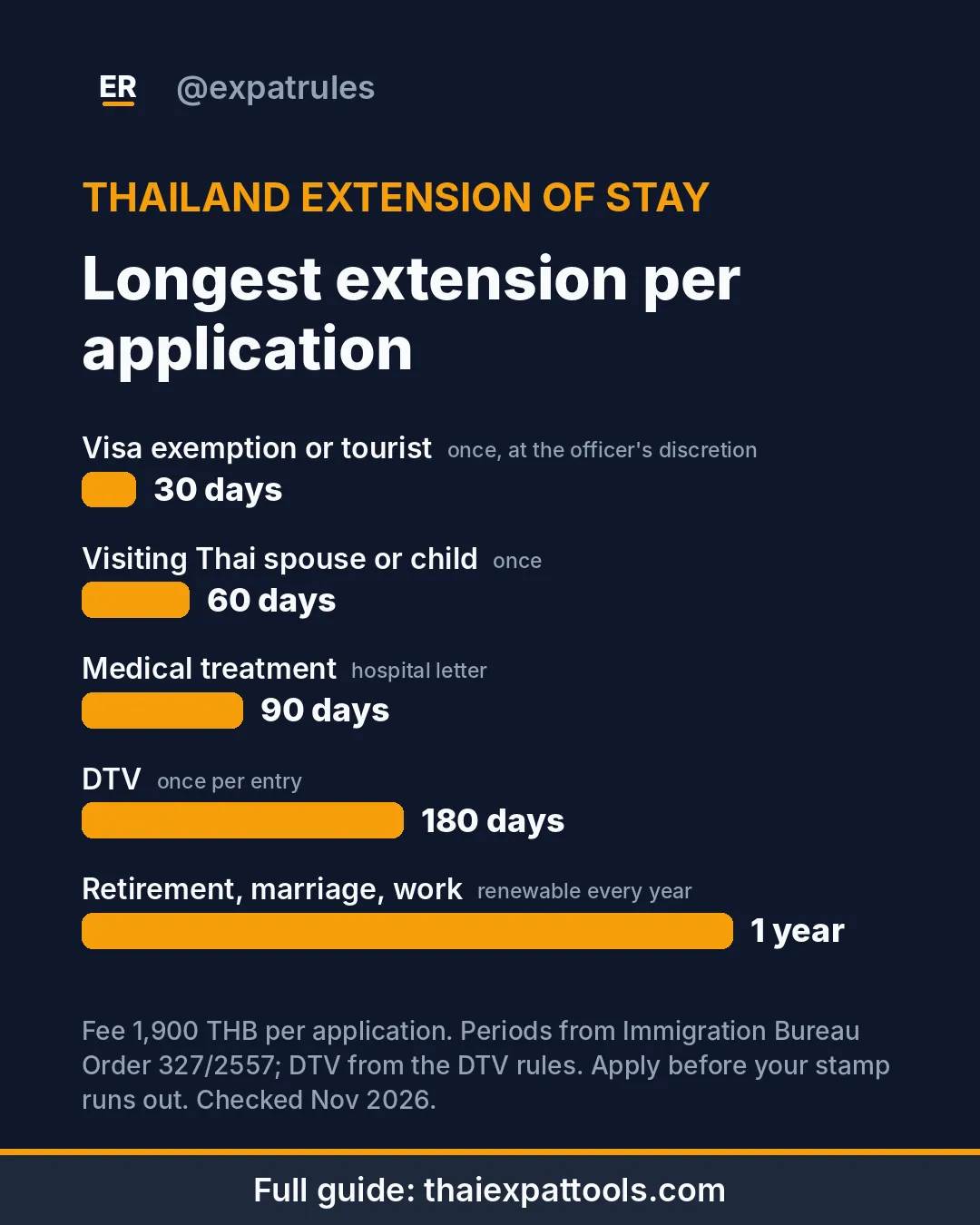
How long can you extend?
The reasons and the longest period for each are set by Immigration Bureau Order 327/2557 (English translation). The common ones for expats and visitors:
| You are in Thailand on | Longest extension | Main condition |
|---|---|---|
| Visa exemption or tourist visa | 30 days | Tourism (clause 2.4); some nationalities excluded |
| Visiting a Thai spouse or child | 60 days, once | Proof of the relationship (clause 2.24) |
| Medical treatment or caring for a patient | 90 days | Letter from the treating hospital’s doctor (clause 2.25) |
| DTV | 180 days, once per entry | Same conditions as the visa |
| Non-O, retirement (age 50+) | 1 year | 800,000 THB in a Thai bank, or 65,000 THB a month, or a mix (clause 2.22) |
| Non-O, spouse of a Thai citizen | 1 year | 400,000 THB in a Thai bank, or 40,000 THB a month (clause 2.18) |
| Non-B, working | 1 year | Work permit, salary and company conditions (clause 2.1) |
| Non-ED, studying | Up to 1 year | Letter from the school (clauses 2.8 and 2.9) |
The DTV figure comes from the DTV rules, not Order 327 (Ministry of Foreign Affairs DTV sheet). For the money tests in detail, see the retirement visa guide and the marriage visa guide.
The 30-day extension after the visa exemption
Since 15 September 2026 most visitors get 30 days visa-free instead of 60 (TAT). One 30-day extension at immigration is still possible under clause 2.4, which brings the total to about 60 days. It is at the officer’s discretion, and you may be asked for an onward ticket (VisasNews). Our 30-day visa exemption guide covers who gets 30 or 15 days.
Documents
Most offices want the same core set. Each office can ask for more, so check its own list.
- Form TM.7 (application for extension of temporary stay), filled in and signed
- Passport, plus copies of the photo page, current visa or extension stamp, and latest entry stamp, each signed
- One photo, 4 x 6 cm, recent
- TM30 receipt for your address. Offices check it before they process an extension; see the TM30 guide
- The fee: 1,900 THB in cash
- Proof for your reason: bank letter and bank book for retirement or marriage, marriage certificate, work permit and company papers, school letter, hospital letter, and so on
What happens on the day
- Get a queue number and hand in your file. Some offices take online bookings first.
- While it is considered, you are allowed to stay. Clause 3 of Order 327 lets the office stamp you as pending for up to 30 days after your old stamp ends. This is common for marriage extensions, which often need a home visit.
- If approved, you get a new stamp. It runs from the end of your previous stamp, not from the day you apply.
- If refused, clause 4 gives you 7 days after your permitted stay ends to leave Thailand. Stay beyond that and you are overstaying, at 500 THB a day up to 20,000 THB. The overstay fine calculator shows the fine and any ban.
Tips
- Apply before your stamp expires. An extension cannot fix a stay that has already run out. Each office sets how early you may apply, so ask yours.
- Travelling after you extend? Get a re-entry permit first, or the extension ends at the border.
- Your 90-day report still applies on a one-year extension. The 90-day report calculator shows your next date.
- Bank letters. In November 2026 Pattaya Mail reported cases where banks would not issue the account letter immigration asks for when the balance was low. These were individual cases, not a published rule change, but get your bank letter early (Pattaya Mail).
- Online extensions are not here yet. The Immigration Bureau’s THIM app lists extensions as a later phase; for now you apply in person (Hua Hin Today).
Sources
- Immigration Act B.E. 2522 (1979), English translation (Section 35: extensions of up to one year)
- Immigration Bureau Order 327/2557, English translation (reasons, longest periods, 30 days pending, 7 days to leave if refused)
- Samut Prakan Immigration: fees (1,900 THB per extension)
- Ministry of Foreign Affairs: DTV information sheet (DTV extension: once per entry, up to 180 days)
- Tourism Authority of Thailand: 30-day visa exemption from 15 September 2026
- VisasNews: 30-day visa-free stay can be extended by 30 days (September 2026; not an official source)
- Pattaya Mail: bank letters for extensions (4 November 2026; reports, not a rule)
- Hua Hin Today: THIM app plans (extensions planned for a later phase)
Rules and office practice change. Check with your local immigration office before you apply.
Check what an overstay would cost if your dates slip →This guide is general information, not legal or tax advice. Rules change, so confirm with Thai Immigration, the Revenue Department or a professional.