TM30 in Thailand (2026): Who Files It, the 24-Hour Rule and the 2,000 THB Fine
Updated Sat, 7 November 2026
Work out your next 90-day report date →TM30 is the form that tells Thai Immigration where a foreigner is staying. It comes from Section 38 of the Immigration Act B.E. 2522 (1979): the house master, owner, possessor of the home or hotel manager must notify immigration within 24 hours of the foreigner arriving (Thailand.go.th).
It is not the same as the 90-day report. The 90-day report is your duty. TM30 is, in law, your landlord’s or host’s duty. In practice it lands on you, because immigration offices ask for the TM30 receipt when you apply for an extension or file a 90-day report.
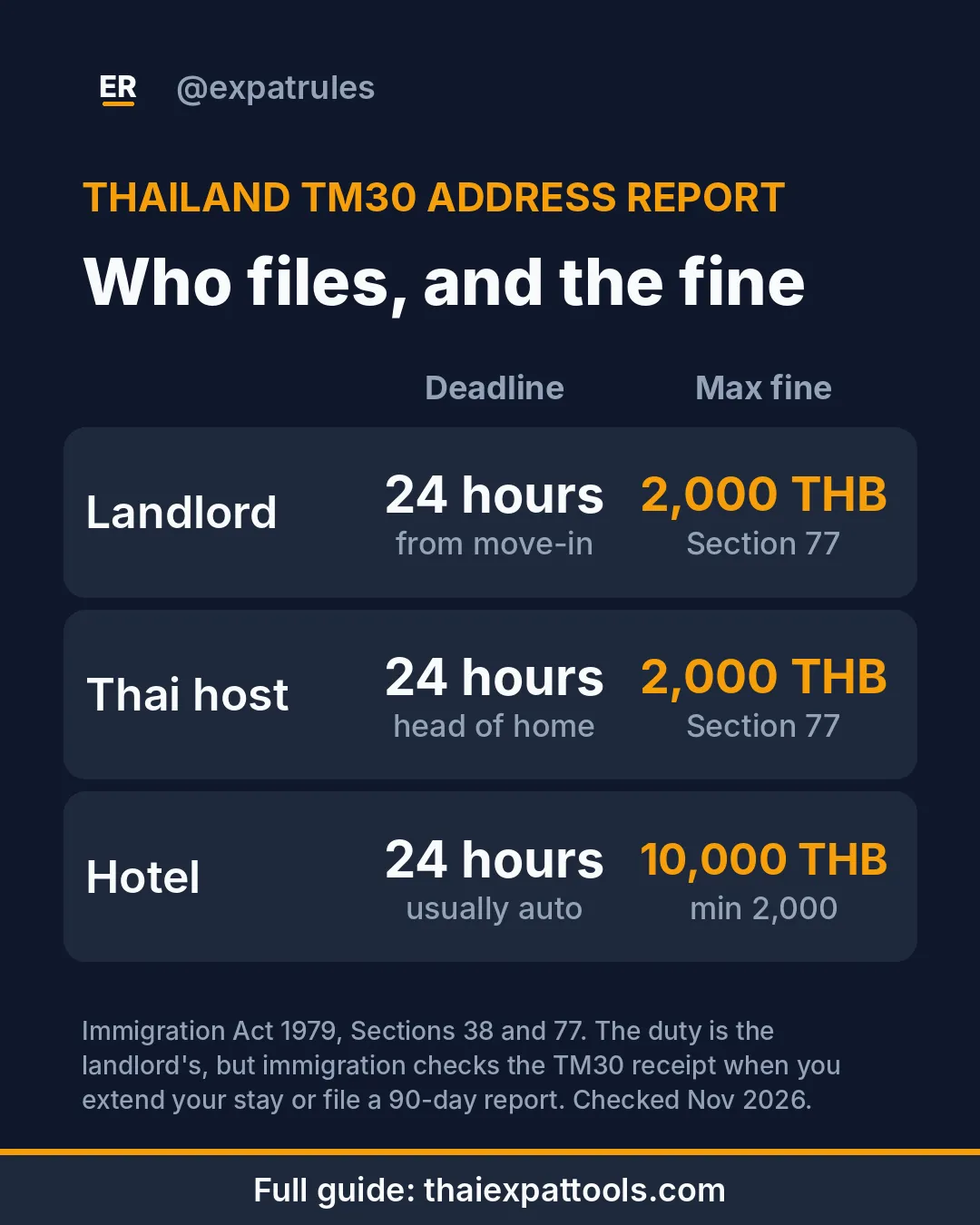
Who has to file?
| Where you stay | Who files the TM30 | Deadline | Fine if not filed |
|---|---|---|---|
| Rented condo, house or room | The owner or landlord | 24 hours | Up to 2,000 THB |
| Home of a Thai partner, friend or relative | The house master (head of the household) | 24 hours | Up to 2,000 THB |
| Hotel, guesthouse, serviced apartment | The hotel or business, usually automatically | 24 hours | 2,000 to 10,000 THB |
| A condo or house you own | You, as the owner | 24 hours | Up to 2,000 THB |
The fines are in Section 77 of the Immigration Act: up to 2,000 THB for whoever fails to comply with Section 38, and 2,000 to 10,000 THB if that person is a hotel manager (Immigration Act 1979, English translation). “House master” means the head of the household, so a tenant who has a foreign guest to stay can be the one who has to file (ThaiLawOnline).
When is a new TM30 needed?
- When you move in to a new address. Always.
- When you come back from abroad to the same address. Since 30 June 2020 a new TM30 is not needed every time you return to the same place within the period already reported. The change came from a Ministry of Interior notification published in the Government Gazette on 16 June 2020 (Tilleke & Gibbins). Some offices still ask for a fresh one after a trip abroad, so check with yours (ThaiLawOnline).
- When you stay somewhere else for a while. A hotel files for you. If you stay in a private home, the host should file.
Travelling inside Thailand is a separate rule. Under Section 37 a foreigner on a temporary stay must notify the local police where they live. ThaiLawOnline describes this as form TM28, due within 48 hours when you move to another province for more than 24 hours. Hotels and registered homes normally cover this in practice.
How to file
The Immigration Bureau accepts TM30 notifications in person, through an authorised person, by registered post or online (Thailand.go.th).
- Online. The owner registers once on the Immigration Bureau’s TM30 system at tm30.immigration.go.th, uploading proof of ownership (title deed or house registration) and a Thai ID card or passport. After approval, each foreign tenant or guest is added with their passport details (SIIT).
- At the immigration office. In Bangkok, the residence notification office is on the 2nd floor of the Muang Thong Thani temporary service centre in Pak Kret, Nonthaburi. Elsewhere, use the immigration office for your province, or the police station if there is no immigration office nearby (Thailand.go.th).
- By registered post to the same office.
Bring or send: the TM30 form, copies of the foreigner’s passport photo page, current visa or extension stamp and latest entry stamp, and a copy of the owner’s ID and proof of ownership or the lease. After the office checks it, you get a receipt slip (or an online confirmation). Keep it with your passport.
Why it matters for your extension
Immigration offices check the TM30 record when you apply for an extension of stay and when you file a 90-day report. Bangkok immigration began rejecting extension applications without a TM30 receipt in March 2019 (BAL).
If no TM30 was filed, the office usually collects the fine, registers the address on the spot and then carries on with your application. Reports from that time mention foreigners paying 800 to 2,000 THB on behalf of their landlords (PKF Thailand). The fine belongs to the landlord, so agree with them who pays before it comes up.
Common mistakes
- Assuming the agent filed it. Nothing is on record unless the owner or the agent with the owner’s login actually filed. Ask for the receipt in your first week.
- Waiting until the extension appointment. Ask the landlord for the TM30 slip as soon as you move in, not the day before your stamp runs out.
- Moving and keeping the old receipt. A receipt is for one address. After a move, the new landlord files a new TM30.
- Confusing TM30 with the 90-day report. You still need to report every 90 days. The 90-day report calculator shows your next window.
Sources
- Thailand.go.th: rules on notification of foreigners’ residence (Section 38, 24 hours, form TM.30, where and how to notify)
- Samut Prakan Immigration: notification of residence of foreigners (who files, in person, by post or online)
- Immigration Act B.E. 2522 (1979), English translation (Sections 37, 38 and 77: fine up to 2,000 THB, hotels 2,000 to 10,000 THB)
- Tilleke & Gibbins: Thailand relaxes TM30 rules (no new TM30 on each return to the same address, from 30 June 2020)
- SIIT, Thammasat University: TM30 residence report (online system, landlord registration)
- ThaiLawOnline: TM30 (house master, TM28, office practice; not an official source)
- BAL: TM30 required before extensions (Bangkok, March 2019)
- PKF Thailand: TM30 enforcement (fines paid by foreigners, 2019)
Practice differs between immigration offices. Check with your local office if you are unsure.
Work out your next 90-day report date →This guide is general information, not legal or tax advice. Rules change, so confirm with Thai Immigration, the Revenue Department or a professional.