Thailand Retirement Visa Extension 2026: The 800,000 THB Bank Rule, 65,000 THB a Month or a Mix
Updated Sat, 14 November 2026
Check if your money meets the retirement visa rules →The yearly retirement extension is how most people aged 50 and over stay in Thailand long term. You hold a Non-Immigrant visa, then apply at your local immigration office for permission to stay one more year. Whether you get it mostly comes down to one thing: showing the right money in the right way.
Our retirement visa guide compares the Non-O, O-A and LTR routes. This guide goes deeper into the money test for the one-year extension.
The three ways to pass the money test
Under clause 2.22 of Immigration Bureau Order 327/2557, you must be 50 or older and meet one of three financial options (English translation; Thailand.go.th):
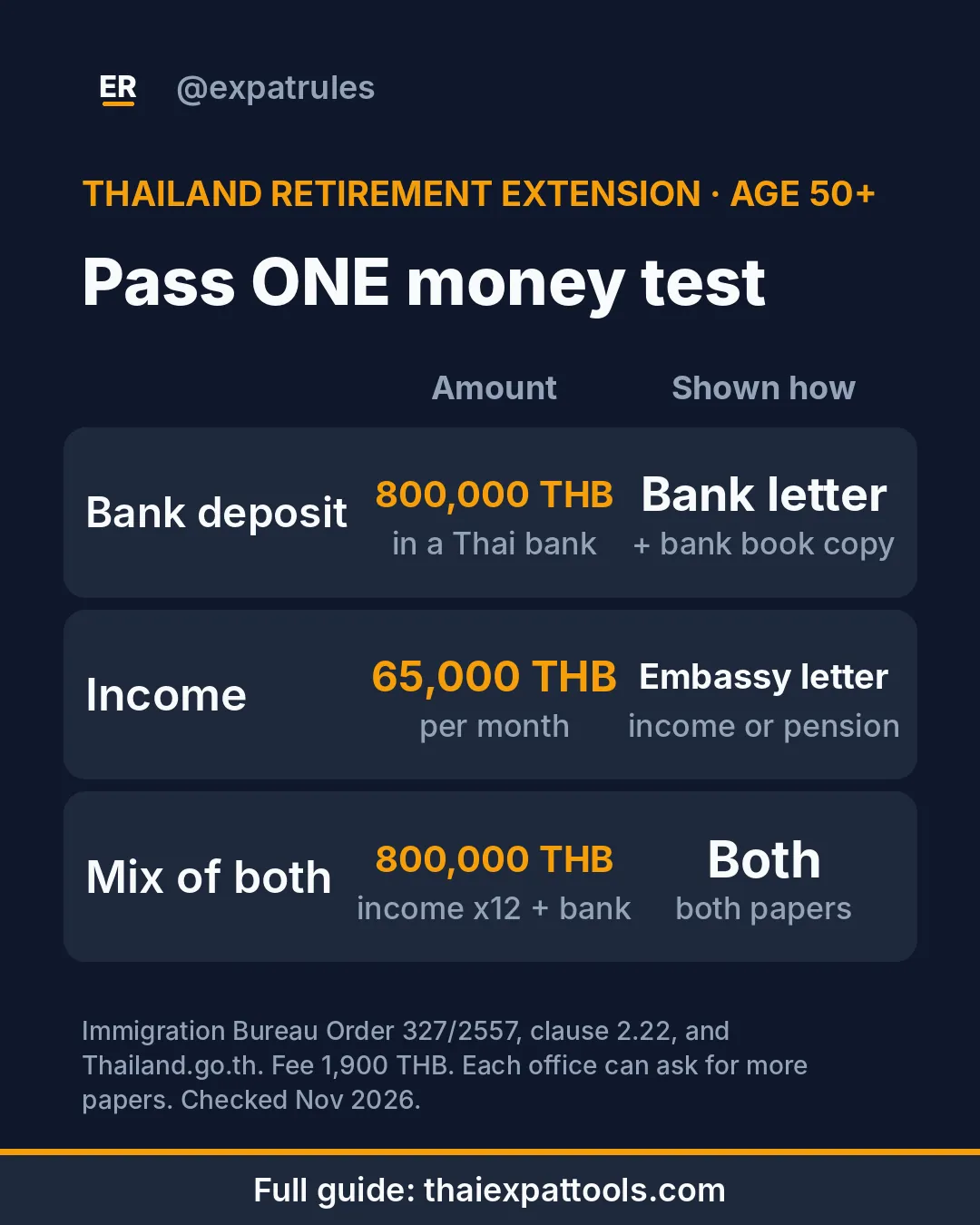
| Option | Amount | How you prove it |
|---|---|---|
| Bank deposit | At least 800,000 THB in a Thai bank account in your name | Letter from your Thai bank, plus a copy of the bank book |
| Monthly income | At least 65,000 THB a month | Income or pension letter certified by your embassy or consulate in Thailand |
| Combination | Yearly income plus Thai bank balance of at least 800,000 THB | Both of the above |
The fee is 1,900 THB for each extension (Samut Prakan Immigration: fees). The extension lasts up to one year.
The bank deposit: how long the money must stay
The bank route has timing rules, and they are easy to get wrong. They are set out by the Immigration Bureau on Thailand.go.th and in Order 327/2557.
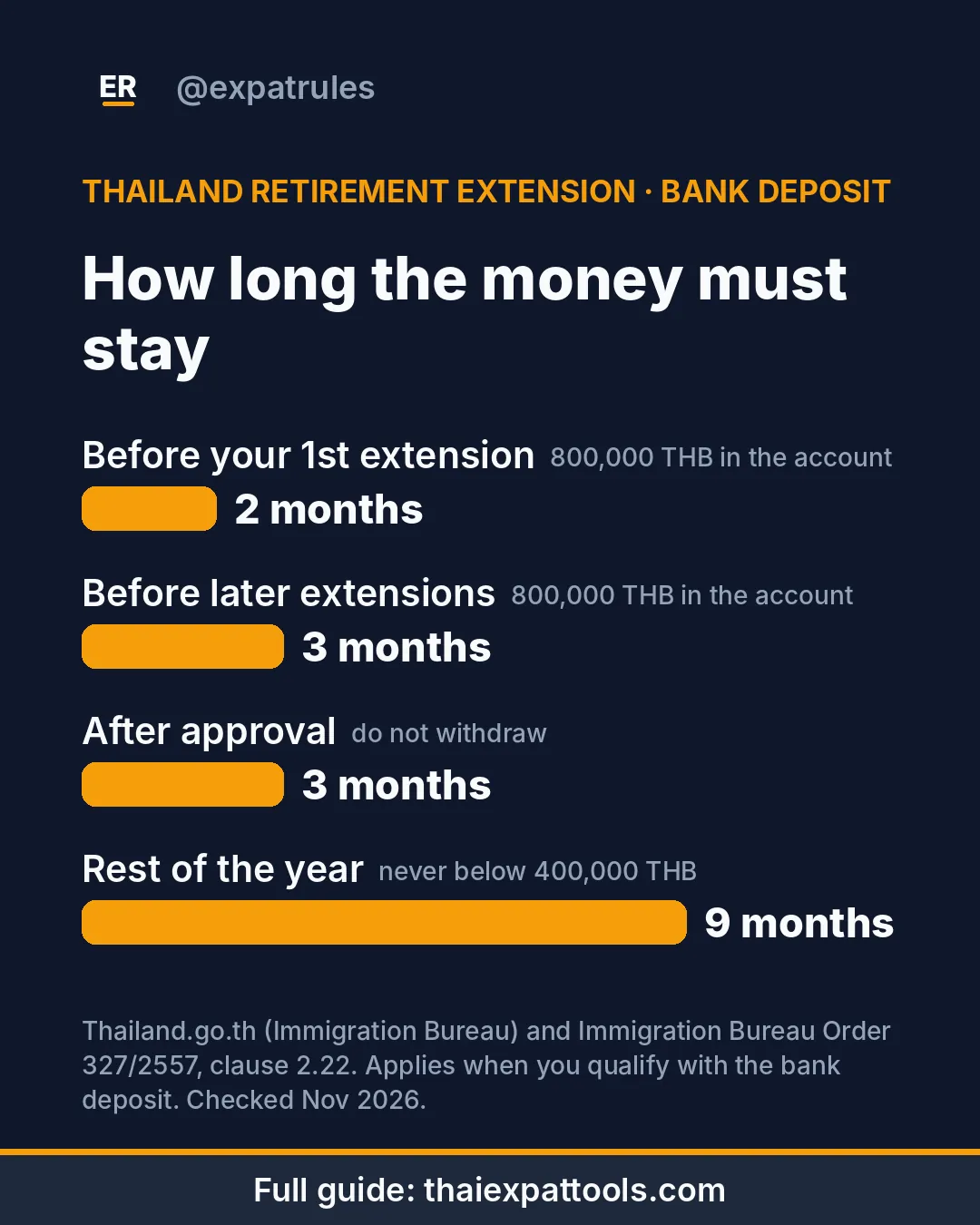
- Before your first extension: the 800,000 THB must have been in the account for at least 2 months before you apply.
- Before later extensions: Order 327 asks for the money to have been there for the past 3 months. Samut Prakan Immigration, for example, wants a bank letter for more than 800,000 THB held for 3 months, plus an ATM slip dated on the day you apply (Samut Prakan Immigration: retirement documents).
- After approval: leave the full amount untouched for 3 months.
- For the rest of the year: you may spend from it, but the balance must never fall below 400,000 THB.
In practice, that means about 400,000 THB stays locked all year, and you need to top the account back up to 800,000 THB at least 3 months before your next renewal.
The income route
If you have a pension or other regular income of 65,000 THB a month or more, you can qualify without a large deposit. You show it with an income or pension letter certified by your embassy or consulate in Thailand (Samut Prakan Immigration). Thailand.go.th gives pensions, interest and dividends as examples of income that counts.
Embassies decide for themselves what letters they issue, and some have changed their services over the years. Check with your own embassy before you rely on this route, and ask your immigration office which evidence it accepts if your embassy no longer certifies income.
The combination route
If you have some income and some savings, you can add them up. Your yearly income plus the money in your Thai bank account must reach at least 800,000 THB on the day you apply (Order 327/2557, clause 2.22).
Example: a pension of 40,000 THB a month is 480,000 THB a year. You would then need at least 320,000 THB in a Thai bank to reach 800,000 THB. You bring both the income letter and the bank letter. Your local office decides how long it wants the bank part to have been in the account, so ask before you apply.
Want to check your own numbers? The retirement visa checker does the sum for you.
Documents to bring
Each office can ask for more, but the core set is (Thailand.go.th; Samut Prakan Immigration):
- Form TM.7, filled in and signed
- Passport and copies of the photo page, visa and latest entry stamp
- Proof of money: bank letter and bank book copy, and/or the embassy income letter
- The fee: 1,900 THB
- TM30 receipt for your address; see the TM30 guide
The steps on the day, what a pending stamp means and what happens if you are refused are in our extension of stay guide.
Common mistakes
- Moving money too late. If the 800,000 THB arrives only a few weeks before you apply, it does not meet the 2- or 3-month rule. Plan from the date you will apply, backwards.
- Spending below 400,000 THB. Letting the balance drop under the minimum breaks the condition you were granted the extension on.
- Forgetting the 90-day report. A one-year extension still needs a report every 90 days; the 90-day report calculator shows your dates.
- Travelling without a re-entry permit. Leaving Thailand without one cancels the extension; see the re-entry permit guide.
- Thinking you can work. A retirement extension does not allow any work in Thailand.
On the O-A visa? The same money test applies, but you also need health insurance of at least 3,000,000 THB (or USD 100,000) of cover (Royal Thai Consulate-General Los Angeles). See the health insurance guide.
Sources
- Thailand.go.th: Application to stay in Thailand in the case of retirement (age 50, 800,000 THB, 65,000 THB a month, 2 months before, 3 months after, 400,000 THB minimum)
- Immigration Bureau Order 327/2557, English translation (clause 2.22: the three options, 3 months for later applications, 60 days for the first)
- Samut Prakan Immigration: list of documents for a retirement extension (bank letter, ATM slip, embassy income letter)
- Samut Prakan Immigration: fees (1,900 THB per extension)
- Royal Thai Consulate-General Los Angeles: Non-Immigrant O-A (O-A health insurance)
Immigration offices apply these rules with some local differences. Check with your own office before you apply.
Check if your money meets the retirement visa rules →This guide is general information, not legal or tax advice. Rules change, so confirm with Thai Immigration, the Revenue Department or a professional.